
'India is not so distant from years of high and entrenched inflationary expectations that it should start trying to play games with the economy the way the West's central bankers think they are entitled to,' argues Mihir S Sharma.

He will be the eighth Deputy Governor to be made Governor at RBI

One incident should not be used to generalise the health of all cooperative banks, says RBI governor Shaktikanta Das.

The central bank tweaked the retail inflation range to 4.8-4.9 per cent in the first half of 2018-19, and 4.7 per cent in the second half.

Central bank sees action as discriminatory, unfair

India's consumer price index (CPI)-based inflation could ease in the coming months thanks to the arrival of kharif crops, lower international commodity prices, and a pass through of lower input costs to consumers, the finance ministry said in its Monthly Economic Review (MER) for October, which was released on Thursday. The MER, however, warned that the global macroeconomic situation remained precarious and a recession in many advanced economies would impact India's exports. "Easing international commodity prices and new Kharif arrival are set to dampen inflationary pressures in the coming months.
The industrial output for the third month in a row remained in the negative territory, contracting 1.5% in January

'We are very watchful about inflation and growth. But the main challenge is economic revival and growth.'

The wider Nifty hit a low of 10,033.35 before finishing at 10,044.10, down 74.15 points or 0.73 per cent.

Analysts are divided on their retail price inflation forecast, with some saying the first quarter numbers will overshoot the RBI target by as much as 60 bps while others are softer in their estimate. Consumer price inflation retreated from its 15-month peak of 7.4 per cent in July to 6.8 per cent in August, much lower than the market expectations, despite vegetable prices remaining elevated at 26.1 per cent. Food inflation eased to 9.9 per cent from 11.5 per cent, led by some cooling of inflation in vegetables, cereals, pulses and milk.

Finance Minister Nirmala Sitharaman has said the recent interest rate hike by the Reserve Bank was not surprising for her but the timing was, asserting that the rising cost of funds will not impact the government's planned infrastructure investments. For the first time since August 2018, RBI had on May 4 delivered a blunt 40 basis points increase in key repo rate to 4.40 per cent, and also hiked the cash reserve ratio by 50 basis points to 4.5 per cent after an unscheduled meeting of the rate setting panel, citing increased inflation pressures following the Ukraine war and the resultant spike in crude oil prices. Retail inflation printed at 6.9 per cent in March and the April reading is forecast to top 7.7 per cent.
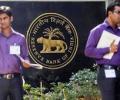
Banks normally park almost 27 per cent of their funds in government securitie.

RBI could opt for a 'deep cut' after winning inflation war, say experts.
Barry Eichengreen, professor of economics and political science, University of California, Berkeley, analyzes the transparency of the Reserve Bank of India, the growth rate of the Indian economy and why he feels globalisation can never be rolled back.
India has been relatively insulated from the severe headwinds in the West. However, with a third of the global economy expected to slip into recession in calendar year 2023, the impact will strongly be felt on India's exports and trade economy, leading economists said in a panel discussion at the Business Standard BFSI Insight Summit in Mumbai on Wednesday. The panel comprised former Reserve Bank of India executive director and former Monetary Policy Committee member Mridul Saggar, State Bank of India Chief Economic Advisor Soumya Kanti Ghosh, Citibank India Chief Economist Samiran Chakraborty, ICRA Chief Economist Aditi Nayar, and IndusInd Bank Chief Economist Gaurav Kapoor. The topic of the panel discussion was No recession in sight: Is India decoupled from developed economies?

In a business friendly move, the Reserve Bank of India on Friday said that Real Time Gross Settlement System (RTGS), used for large value transactions, will be made available round-the-clock from December. In December 2019, the National Electronic Funds Transfer (NEFT) system was made available on a 24x7x365 basis. Currently, RTGS is available for customers from 7.00 am to 6.00 pm on all working days of a week, except second and fourth Saturdays of every month.

'If the RBI now only prints Rs 100 in small denomination notes and the remaining amount is printed in Rs 500 and Rs 2,000 denominations, then by March-end the central bank can completely normalise the cash crunch situation.'

Given the various risks to growth, one could argue for rate cuts to be deeper than the 5 per cent terminal repo rate that we are projecting at this stage, says Kaushik Das.

Rajan said the process of dialogue with the government did not reach a stage where he could have agreed to stay on

'There are deeper, underlying, forces at work and we need institutional arrangements to guard against them.'
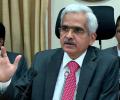
To a specific question on the change in RBI's stance from "neutral" to "accommodative", Das said it means that there will not be any rate hike from here on.

Rajan had overturned the majority opinion of the members and chose to hold the rates at the last monetary policy review in October.

With the 50 bps rate cut now more banks are expected to reduce their base rate.
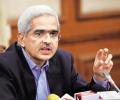
A staunch defender of demonetisation, it would be interesting to see how he handles the government's increasing demand for more cash from the RBI, and letting some weak banks get out of prompt corrective action.

If this turns into reality, India's gross domestic product (GDP) growth will be the lowest since 2012-13, which could severely hit job creation and income growth in the near term.

The bigger worry is that its effects could linger well into the next financial year.

The IHS Markit India Manufacturing PMI rose from 51.2 in November to 52.7 in December. Factories benefited from a rebound in demand, and responded by scaling up production to the greatest extent since May. As per the survey, new work orders witnessed marked improvement, with the pace of expansion picking up to the fastest since July.
With inflation remaining at elevated levels, central banks around the world, including the Reserve Bank of India (RBI), will kill excess demand in economy over the next six to eight months, sources in the know said. They also indicated that there could be a rate hike in June, when the inflation forecast for the current financial year would be raised. The RBI, the sources said, might announce more steps such as raising the limit on held-to-maturity (HTM) bonds to support government borrowings but might not come out with any further quantitative easing GSAP (Government Securities Acquisition Programme) measures.

Costlier vegetables slowly pushed retail inflation, which had remained well within the Reserve Bank's comfortable level of 4 per cent during most part of 2019, peaked to more than three-year high of 5.54 per cent in November.

The RBI may grant licences for setting up small finance and payment banks by April 2015.

'The rising cost of construction, the cost of doing business, high compliance, and inflation/interest rates going up have already reduced returns to single digits.'

The Reserve Bank of India (RBI) on Wednesday announced to increase the policy repo rate by 50 basis points to 4.9 per cent, the second hike in five weeks aimed at quelling the inflation. The MPC vote was unanimous and has decided to keep stance withdrawal from accommodative, RBI Governor Shaktikanta Das said in a press conference on Wednesday. The decision was taken during a three-day meeting of the RBI's Monetary Policy Committee (MPC) to review the interest rates in the country. The MPC voted unanimously to increase the policy repo rate by 50 bps to 4.90 per cent," Das said.
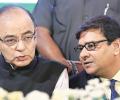
'For the RBI, for a central bank, reputational risk is the worst risk.' 'Credibility is the worst risk,'

Rate cuts are unlikely to be aggressive, in our view.

India's services sector activity moderated further in January as new business rose at a noticeably slower rate amid the escalation of the pandemic, reintroduction of restrictions and inflationary pressures, a monthly survey said on Thursday. The seasonally adjusted India Services Business Activity Index fell to 51.5 in January, down from 55.5 in December, pointing to the slowest rate of expansion in the current six-month sequence of growth. For the sixth straight month, the services sector witnessed an expansion in output.
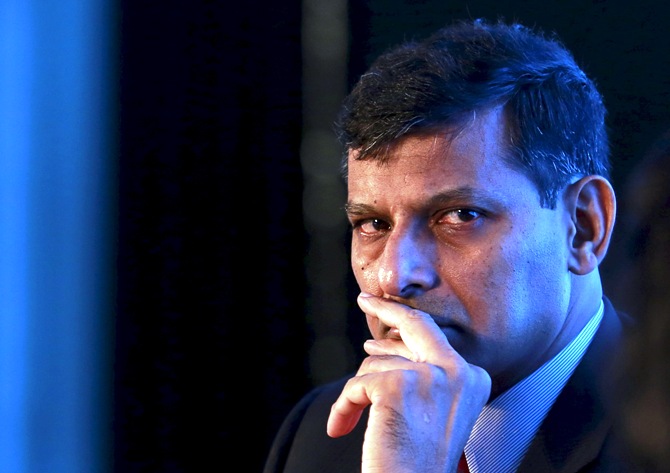
We need a change in mindset, says the RBI Governor.

'The no-rate cut policy and preference to wait for the Budget and clarity on the fiscal front demonstrate RBI Governor Shaktikanta Das is maturing in his new role,' notes Tamal Bandyopadhyay.

The principal challenge for Rajan's successor is to work with the Bank Board Bureau and the finance ministry to complete these processes of banking reform.

A 13-member group, headed by RBI Executive Director R Gandhi, has made various recommendations on G-Sec market, retail participation and interest rate derivatives market.

Rising crude oil prices, traction in China equities and inflation concerns back home are casting a shadow on the Indian equity markets in the short term, believe analysts at Jefferies. They said this could see the markets remaining range-bound in the near term before the next leg up.
 © 2026 Rediff.com - Advertise with us - Disclaimer - Privacy Policy - Sitemap - Feedback - About us - Terms of use - Grievances